


Matrixyl vs Copper Peptides: Which Is Better for Aging Skin?

Updated: Sep 1
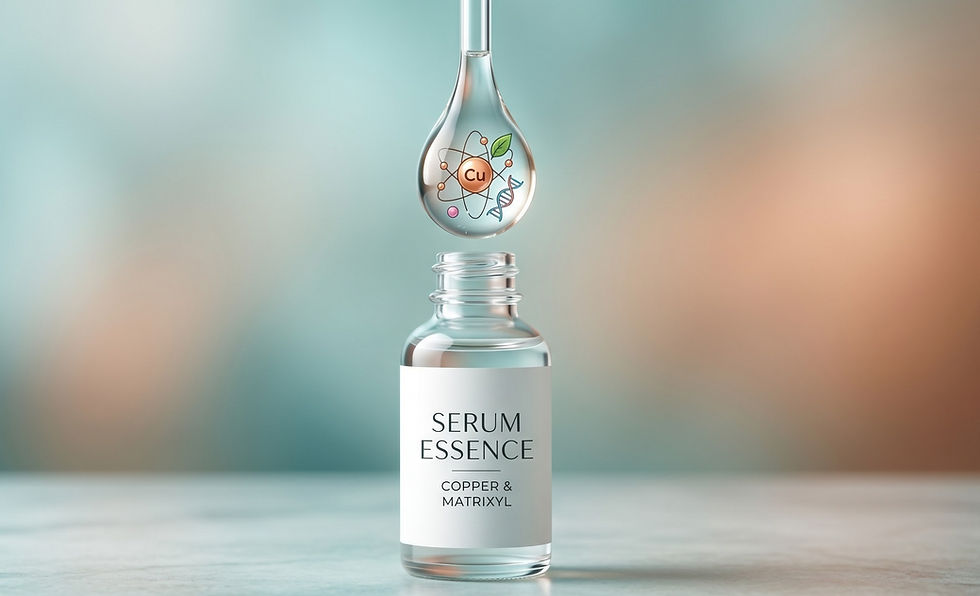
Peptides have quietly become one of the most talked-about ingredients in modern skincare and for good reason. These short chains of amino acids act as cellular messengers, signaling the skin to produce collagen, build elastin, and repair its barrier from within.
But if you've spent any time browsing serums and creams, you've probably run into two names that keep coming up: copper peptides and Matrixyl. Both are well-researched and genuinely effective, but they work in different ways and suit different concerns. Here's how they compare.
What are copper peptides (GHK-Cu)?
Copper peptides are naturally occurring compounds that combine the peptide GHK (Glycyl-L-Histidyl-L-Lysine) with a copper ion. Your body already releases them during tissue repair — they're essentially a healing signal.
When applied to the skin, copper peptides encourage the same regenerative response: clearing out old, damaged collagen and replacing it with fresher tissue. They also support antioxidant defenses by activating superoxide dismutase, one of the skin's key natural enzymes.
One underrated benefit: copper peptides work well on the scalp too. They can help improve follicle health, increase hair density, and may help slow hair thinning by blocking DHT, the hormone most associated with hair loss.
What is Matrixyl?
Matrixyl is a family of synthetic peptides developed by the French company Sederma. The two most common versions are Matrixyl 3000 (a blend of Palmitoyl Tripeptide-1 and Palmitoyl Tetrapeptide-7) and Matrixyl Synthe'6.
Unlike copper peptides, which support broad tissue repair, Matrixyl has a more specific focus: it mimics the signal of broken-down collagen, prompting the skin to ramp up production of new Collagen I, III, IV, and fibronectin. In practical terms, this translates to smoother texture, reduced wrinkle depth, and firmer-feeling skin over time.
It's also a relatively easy ingredient to formulate with — stable and compatible with most other actives, including hyaluronic acid, ceramides, and gentle acids.

How do they compare?
Feature | Copper peptides (GHK-Cu) | Matrixyl |
How it works | Promotes tissue remodeling and antioxidant defense | Stimulates collagen synthesis |
Best for | Redness, barrier repair, elasticity, hair and scalp health | Fine lines, deep wrinkles, sagging, firmness |
Texture | Typically a thin, blue-tinted serum | Works well in creams and eye treatments |
Ingredient pairing | Avoid mixing with vitamin C, AHAs/BHAs, or retinoids in the same step | Stable — compatible with most other actives |
Which one is right for you?
If your main concerns are fine lines, deeper wrinkles, and loss of firmness, Matrixyl is usually the better starting point. It's reliable, well-tolerated by most skin types, and layers easily into an existing routine.
Worth trying for wrinkles & firmness
A Matrixyl-based moisturizer that also contains ceramides and hyaluronic acid — a good option if you want to combine peptide treatment with daily hydration in one step.
If you're dealing with redness, a compromised barrier, or want to address skin health at a structural level — or if scalp thinning is a concern — copper peptides are worth exploring. They take a broader approach to repair and tend to work over a longer timeframe.
Worth trying for scalp & hair
Combines structural peptides with biotin, niacinamide, and botanical extracts (rosemary, nettle, burdock root). Designed to be massaged into the scalp and left in — works well as part of an evening routine.
Can you use both?
Yes, and they work well together when kept in the right places:
Morning: Matrixyl-based serum or moisturizer — it pairs well with SPF and sits comfortably under makeup.
Evening: Copper peptides, away from any retinoids or strong acids. If you're also using a scalp serum, apply it after skincare, massaging in gently to encourage absorption.
Comments